
For many organizations, the largest share of their carbon footprint doesn't come from their own facilities or purchased electricity—it comes from activities across their value chain.
The emissions generated when suppliers manufacture raw materials, employees travel for work, products are transported, customers use those products, and materials are eventually disposed of all contribute to an organization's overall climate impact. These indirect emissions are collectively known as Scope 3 emissions.
While they are often the most difficult emissions to measure, they are also among the most significant. For many businesses, Scope 3 emissions account for more than 70% of total greenhouse gas (GHG) emissions, making them a critical component of any carbon footprint assessment, net-zero strategy, or sustainability reporting programme.
This guide explains what Scope 3 emissions are, the difference between upstream and downstream emissions, all 15 Scope 3 categories defined by the GHG Protocol, and practical steps organizations can take to begin measuring and managing them.
Key Takeaways
- Scope 3 emissions are indirect emissions occurring throughout an organization's value chain.
- The GHG Protocol defines 15 Scope 3 categories, divided into upstream and downstream activities.
- For most organizations, Scope 3 represents the largest proportion of total greenhouse gas emissions.
- Not every category is material for every business; a screening assessment helps identify the most significant sources.
- Measuring Scope 3 emissions supports climate reporting, regulatory compliance, investor expectations, and emissions reduction strategies.
What Are Scope 3 Emissions?
The Greenhouse Gas Protocol, the world's most widely used greenhouse gas accounting standard, classifies organizational emissions into three categories:
Scope 1 – Direct Emissions
These are emissions from sources that an organization owns or controls directly.
Examples include:
- Fuel burned in company vehicles
- Natural gas used in boilers
- Manufacturing processes
- Refrigerant leakage
Scope 2 – Indirect Energy Emissions
Scope 2 covers emissions associated with purchased energy consumed by the organization.
This includes:
- Purchased electricity
- Steam
- Heating
- Cooling
Although the emissions occur at the energy producer's facility, they are reported by the organization consuming that energy.
Scope 3 – Other Indirect Emissions
Scope 3 includes all other indirect emissions that occur across an organization's value chain but are not included within Scope 2.
These emissions occur both:
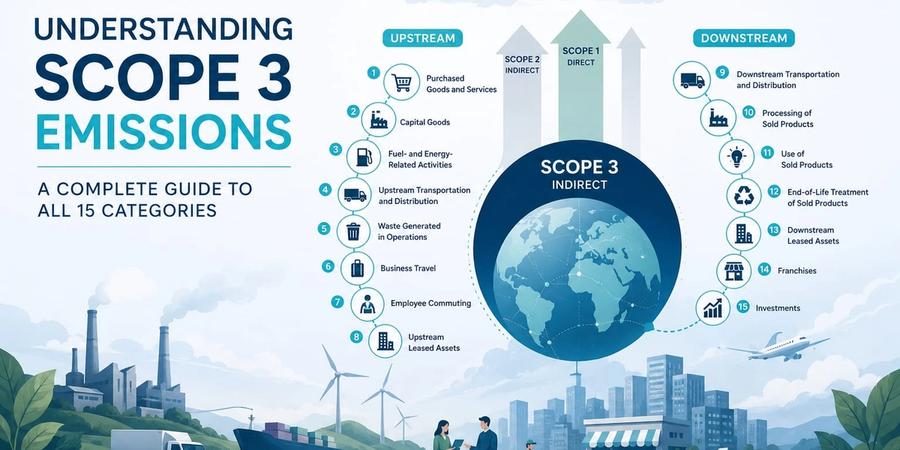
- Upstream — before products or services reach the organization.
- Downstream — after products leave the organization and reach customers.
Because they extend beyond an organization's direct operations, Scope 3 emissions are often the largest—and the most complex—to measure.
Why Are Scope 3 Emissions Important?
Many organizations initially focus on reducing emissions from their own operations. However, for industries such as manufacturing, retail, consumer goods, technology, financial services, and construction, operational emissions often represent only a small proportion of the overall carbon footprint.
Understanding Scope 3 emissions helps organizations:
- Develop a complete carbon footprint.
- Identify emissions hotspots across the value chain.
- Engage suppliers on emissions reduction initiatives.
- Improve climate-related risk management.
- Meet reporting requirements under sustainability frameworks.
- Support net-zero commitments.
- Respond to increasing investor, customer, and regulatory expectations.
Without measuring Scope 3 emissions, organizations may overlook the majority of their climate impact and the greatest opportunities for emissions reduction.
Understanding Upstream and Downstream Emissions
Scope 3 emissions are divided into two broad groups.
Upstream Emissions
Upstream emissions occur before products or services reach the organization.
Typical upstream activities include:
- Purchasing raw materials
- Manufacturing components
- Supplier transportation
- Business travel
- Employee commuting
- Waste generated during operations
These emissions are largely influenced by supplier practices and procurement decisions.
Downstream Emissions
Downstream emissions occur after products or services leave the organization.
Examples include:
- Distribution to customers
- Product processing
- Product use
- Product disposal
- Franchises
- Investments
Depending on the industry, downstream emissions may represent the largest portion of an organization's overall carbon footprint.
The 15 Scope 3 Categories Explained
The GHG Protocol divides Scope 3 emissions into 15 reporting categories.
Category
Description
Typical High-Impact Industries
1. Purchased Goods and Services
Emissions embedded in purchased raw materials, products, and services.
Manufacturing, Retail, Consumer Goods
2. Capital Goods
Emissions associated with producing machinery, equipment, vehicles, and buildings purchased by the organization.
Manufacturing, Construction
3. Fuel- and Energy-Related Activities
Upstream emissions from fuel production and electricity generation not already included in Scope 1 or Scope 2.
Most industries
4. Upstream Transportation and Distribution
Transportation of purchased goods and internal logistics before products reach the organization.
Manufacturing, Retail
5. Waste Generated in Operations
Emissions from treatment and disposal of operational waste.
All industries
6. Business Travel
Employee travel by air, rail, road, and accommodation for business purposes.
Professional Services, Technology
7. Employee Commuting
Daily travel between employees' homes and workplaces.
All industries
8. Upstream Leased Assets
Emissions from assets leased by the organization but owned by another party.
Property, Manufacturing
9. Downstream Transportation and Distribution
Transportation and storage of products after sale.
Retail, Manufacturing
10. Processing of Sold Products
Emissions generated when business customers further process sold products.
Chemicals, Metals, Food
11. Use of Sold Products
Emissions resulting from customers using sold products throughout their lifetime.
Automotive, Electronics, Energy
12. End-of-Life Treatment of Sold Products
Emissions from recycling, landfill, incineration, or disposal after product use.
Consumer Goods, Packaging
13. Downstream Leased Assets
Emissions from assets owned by the organization and leased to others.
Real Estate, Equipment Leasing
14. Franchises
Emissions from franchise operations not directly controlled by the reporting organization.
Hospitality, Food & Beverage
15. Investments
Emissions associated with equity investments, debt, project finance, and managed assets.
Financial Services
Which Scope 3 Categories Matter Most?
Not every category is relevant to every organization.
For example:
- A manufacturer may find that Purchased Goods and Services and Use of Sold Products account for the majority of emissions.
- A financial institution will often identify Investments as its largest emissions source.
- A professional services firm may find Business Travel and Employee Commuting to be more significant.
- A property owner may focus on Downstream Leased Assets.
Conducting a materiality or screening assessment helps organizations prioritise the categories with the greatest environmental impact.
Common Challenges in Measuring Scope 3 Emissions
Calculating Scope 3 emissions can be significantly more complex than measuring operational emissions.
Common challenges include:
- Limited supplier data
- Inconsistent data quality
- Reliance on industry-average emission factors
- Complex global supply chains
- Double-counting risks
- Changing reporting boundaries
- Limited visibility over downstream activities
Despite these challenges, organizations are increasingly improving data quality by engaging suppliers, using primary activity data where available, and refining calculations over time.
How Are Scope 3 Emissions Calculated?
Organizations typically use one or more of the following calculation approaches:
Spend-Based Method
Uses financial expenditure combined with industry-average emission factors.
Suitable for screening assessments and organizations with limited supplier data.
Activity-Based Method
Calculates emissions using operational activity data such as tonnes of material purchased, kilometres travelled, or tonnes of waste generated.
Provides greater accuracy than spend-based estimates.
Supplier-Specific Method
Uses emissions data provided directly by suppliers.
This is generally considered the most accurate approach where reliable supplier information is available.
Hybrid Approach
Many organizations combine spend-based, activity-based, and supplier-specific methods to balance accuracy with data availability.
Where Should Organizations Start?
Attempting to calculate every Scope 3 category in detail from the outset can quickly become overwhelming.
A more effective approach is to:
- Conduct a screening assessment across all 15 categories.
- Identify the categories that are material to your business.
- Prioritise the largest emissions sources.
- Improve data quality over successive reporting cycles.
- Develop supplier engagement and emissions reduction initiatives.
This phased approach enables organizations to build a credible Scope 3 inventory while continuously improving reporting quality.
How Climate Maven Can Help
Understanding and calculating Scope 3 emissions requires a structured approach, robust data collection, and alignment with recognised carbon accounting standards.
At Climate Maven, we help organizations measure, manage, and report their value chain emissions with confidence.
Our Scope 3 advisory services include:
- Scope 3 screening and materiality assessments
- Greenhouse Gas (GHG) inventories
- Value chain emissions calculations
- Supplier engagement support
- Carbon accounting aligned with the GHG Protocol
- Sustainability reporting support
- Net-zero strategy development
- Climate disclosure support for CDP, CSRD, and other reporting frameworks
Whether you're preparing your first carbon footprint or enhancing an existing greenhouse gas inventory, our experts can help you develop a robust and defensible Scope 3 emissions assessment.
Frequently Asked Questions
Are Scope 3 emissions mandatory?
Requirements vary by jurisdiction and reporting framework. However, many sustainability reporting standards, investor requests, and customer supply chain programmes increasingly expect organizations to disclose material Scope 3 emissions.
Which Scope 3 category is usually the largest?
It depends on the industry. Purchased Goods and Services, Use of Sold Products, and Investments are often among the largest categories for many organizations.
Do all organizations need to report all 15 categories?
No. Organizations should assess all categories and report those that are material to their operations and value chain.
Why are Scope 3 emissions difficult to measure?
Unlike Scope 1 and Scope 2 emissions, Scope 3 relies heavily on information from suppliers, customers, logistics providers, and other external partners, making data collection more challenging.
Can Scope 3 emissions be verified?
Yes. Organizations can seek independent verification or assurance of Scope 3 calculations, although the level of assurance depends on data quality and the methodologies used.
Final Thoughts
Scope 3 emissions often represent the largest share of an organization's greenhouse gas emissions and can reveal risks and opportunities that are not visible through operational emissions alone. Although measuring value chain emissions can be complex, understanding where emissions occur is the first step towards meaningful climate action.
By taking a structured, materiality-based approach and continually improving data quality, organizations can build a robust Scope 3 inventory that supports regulatory reporting, investor expectations, supply chain engagement, and long-term decarbonisation goals.
As sustainability reporting continues to evolve, organizations that proactively measure and manage Scope 3 emissions will be better positioned to strengthen resilience, enhance transparency, and demonstrate credible progress towards their climate commitments.