
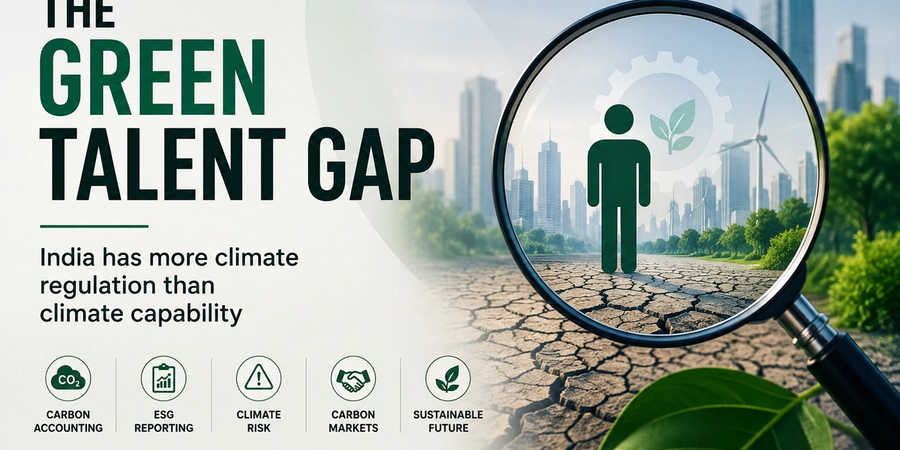
As sustainability moves from voluntary initiatives to regulatory compliance, businesses across India are facing a common challenge - not a shortage of jobs, but a shortage of people who can do the work.
Across industries, organizations are looking for professionals who can prepare credible greenhouse gas (GHG) inventories, respond confidently to disclosure frameworks such as CDP and BRSR, assess climate risks, and support decarbonization strategies. Yet these skills remain scarce, creating one of the biggest barriers to successful sustainability implementation.
The conversation has shifted. Companies are no longer asking whether sustainability matters - they're asking where to find professionals who can deliver it.
A Growing Demand for Green Skills
India's transition toward a low-carbon economy is accelerating. Sustainability reporting requirements, investor expectations, supply chain regulations, and national climate commitments are collectively driving demand for skilled sustainability professionals.
Industry estimates suggest that India could generate millions of green jobs over the next two decades, spanning renewable energy, sustainable manufacturing, ESG reporting, carbon markets, climate finance, waste management, and circular economy initiatives.
At the same time, regulations are making sustainability expertise a business necessity:
- Business Responsibility and Sustainability Reporting (BRSR) for India's largest listed companies.
- Carbon Border Adjustment Mechanism (CBAM) affecting exporters to the European Union.
- Corporate Sustainability Reporting Directive (CSRD) influencing Indian subsidiaries and suppliers connected to European businesses.
- India's evolving Carbon Credit Trading Scheme (CCTS) introducing new compliance expectations for energy-intensive sectors.
These developments are transforming sustainability from a voluntary corporate initiative into a strategic business function.
The Real Challenge Isn't Awareness - It's Capability
Most graduates and early-career professionals today understand ESG terminology. Many can explain concepts such as net zero, Scope 3 emissions, or materiality assessments.
However, employers consistently highlight a different challenge: practical capability.
Organizations need professionals who can:
- Develop accurate GHG inventories.
- Calculate Scope 1, Scope 2, and Scope 3 emissions.
- Prepare disclosure responses aligned with CDP, BRSR, CSRD, or other reporting frameworks.
- Analyse climate-related risks and opportunities.
- Interpret sustainability data and convert it into actionable business insights.
- Support third-party verification and assurance processes.
Understanding sustainability concepts is only the first step. Delivering technically sound, audit-ready work is where the real talent gap exists.
Where Demand Is Highest
Several specialised areas are experiencing particularly strong demand.
Carbon Accounting and GHG Inventories
Accurate emissions accounting forms the foundation of every climate strategy. Organizations require professionals who can collect activity data, apply recognised methodologies, calculate emissions, and maintain transparent documentation that withstands verification.
ESG Reporting and Sustainability Disclosures
Preparing reports under frameworks such as CDP, BRSR, and CSRD requires much more than strong writing skills. It demands technical understanding of disclosure requirements, performance metrics, governance expectations, and supporting evidence.
Climate Risk Assessment
Companies increasingly need specialists who can evaluate both physical climate risks and transition risks while integrating these findings into enterprise risk management and long-term business planning.
Carbon Markets and CCTS Readiness
With India's Carbon Credit Trading Scheme gradually taking shape, sectors such as cement, aluminium, textiles, petrochemicals, and other energy-intensive industries are expected to require professionals familiar with compliance carbon markets and emissions management.
Supply Chain Sustainability
Scope 3 emissions often represent the largest share of an organization's carbon footprint. Collecting supplier data, improving data quality, and engaging value-chain partners have become essential capabilities for sustainability teams.
How Green Careers Will Evolve
The next decade is expected to bring distinct phases in sustainability talent demand.
2026–2028: Reporting and Compliance
As disclosure requirements expand, demand will remain high for ESG analysts, carbon accountants, sustainability reporting specialists, and ESG data professionals capable of meeting increasingly complex reporting obligations.
2028–2031: Decarbonization and Implementation
Organizations will increasingly focus on reducing emissions rather than simply measuring them. Skills in decarbonization planning, renewable energy integration, energy efficiency, and emissions reduction strategies will become even more valuable.
2031–2035: Climate Resilience and Nature
Climate adaptation, water stewardship, biodiversity, circular economy practices, and nature-related disclosures are expected to become central components of corporate sustainability strategies, creating demand for a broader range of interdisciplinary expertise.
Each stage builds upon the previous one, meaning the need for qualified sustainability professionals will continue to grow rather than diminish.
What This Means for Businesses
For many organizations, hiring a general sustainability professional alone is no longer sufficient.
Modern sustainability programmes require a combination of technical expertise, regulatory knowledge, analytical capability, and strategic thinking. While internal teams play a critical role in coordination and stakeholder engagement, many companies also rely on specialised advisory support for technically demanding areas such as GHG accounting, disclosure preparation, climate risk assessments, and decarbonization planning.
Investing in the right expertise early helps organizations improve reporting quality, strengthen compliance, and build greater confidence among investors, regulators, customers, and other stakeholders.
Turning Sustainability into Business Value
The green transition is creating more than new regulations-it is creating a new workforce.
As sustainability becomes embedded across finance, operations, supply chains, and corporate strategy, professionals with practical climate and ESG skills will play an increasingly important role in helping businesses navigate change.
For organizations, the challenge is no longer whether sustainability should be integrated into the business. The challenge is ensuring they have the capability to do it effectively.
At Climate Maven, we support organizations with technical sustainability services, including greenhouse gas accounting, ESG reporting, climate disclosures, decarbonization roadmaps, and regulatory readiness-helping businesses move beyond compliance toward long-term resilience and sustainable growth.